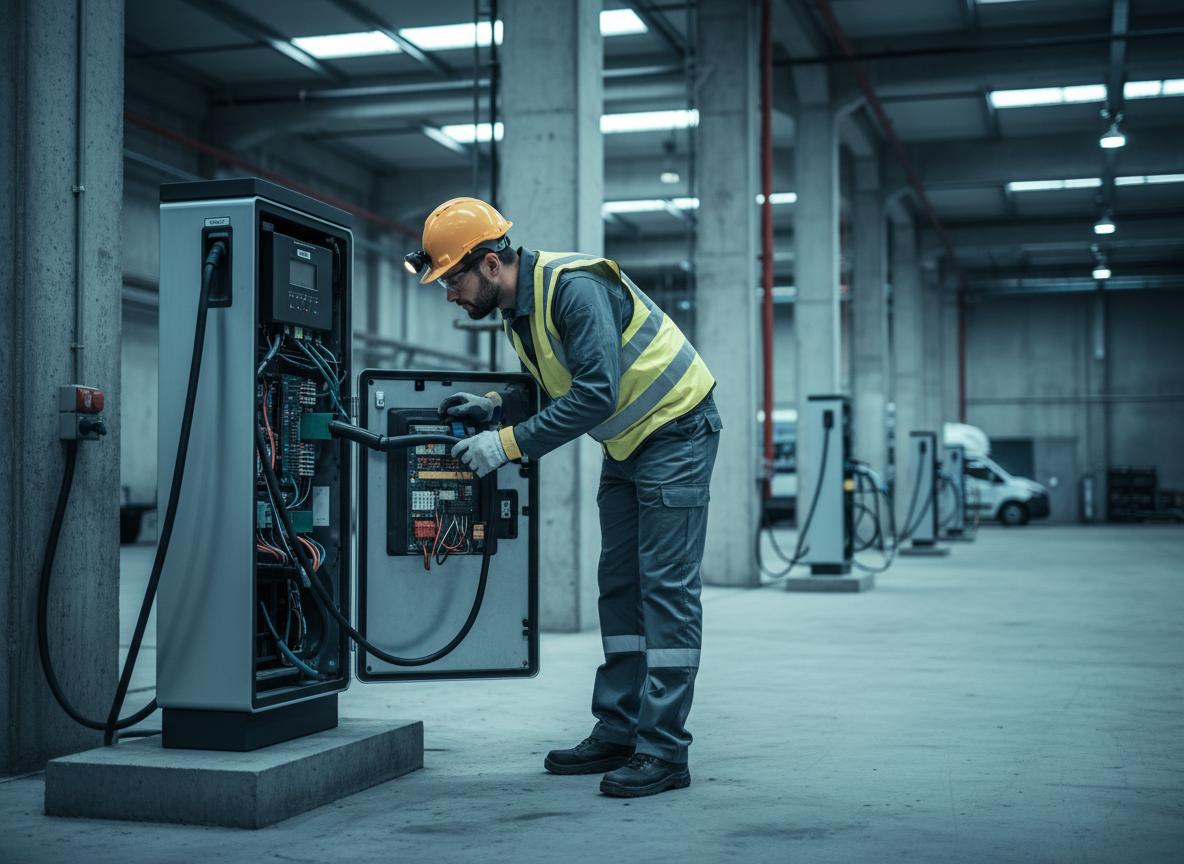
Total InCharge technician installing and wiring a commercial EV charging station power cabinet

EV Charging Hardware & Engineering

Total InCharge specifies, procures, and installs commercial EV charging hardware engineered around the electrical realities of your site. From high-power EV charging systems to universal EV charging hardware selection, it's backed by licensed electrical engineering, not a catalog page.

Charging hardware we install.

We specify hardware to the site, not the other way around. That means liquid-cooled DC fast chargers for high-cycle sites, dual-port commercial EV chargers where stall efficiency matters, and smart EV charging stations that report status back to your network from day one. Where a site needs to scale past today's demand, we plan for a megawatt charging system (MCS) pathway rather than a hardware dead end. Our EVSE procurement process is vendor-neutral: we source the equipment that fits your budget, timeline, and duty cycle, not whichever brand has the best margin.

Electrical and power engineering that holds up.

Most commercial EV projects live or die on electrical capacity, not chargers. Before we spec equipment, we confirm EV charging station transformer capacity against your actual demand curve, then design the electrical layout for EV chargers — conduit runs, panel placement, and circuit sizing — to minimize both material cost and future rework. Where a site is adding chargers to an existing building, we size and place switchgear for EV charging infrastructure so expansion doesn't mean tearing open walls again, and we plan EV charging power distribution to keep voltage drop and demand charges under control.

Site assessment and civil engineering.

Every project starts with a real EV charging station site assessment: existing service capacity, parking geometry, ADA routes, and utility proximity, walked in person rather than estimated from a satellite photo. From there our EV infrastructure civil engineering covers trenching, foundations, bollards, and striping — the physical work that has to be right before a single charger goes on a pedestal.

Microgrids and battery storage.

On sites where utility capacity is the constraint, microgrids for EV charging stations and battery energy storage for EV chargers let you install more charging power than your service could otherwise support, shave demand charges, and keep chargers online during a grid event.

Frequently Asked Questions

Do you install DC fast charging station infrastructure or just Level 2? +
Both. We install DC fast charging station infrastructure and Level 2 commercial EV chargers, and typically recommend a mix based on dwell time and turnover at your site.
How do you handle EV charger hardware compatibility across brands? +
We design around EV charger hardware compatibility and OCPP standards from the start, so your site isn't locked into a single manufacturer for future expansion or service.
What if my site doesn't have enough electrical capacity? +
We assess EV charging station transformer capacity and utility interconnection for EV charging early. Where capacity is short, we scope grid upgrades for EV charging, microgrids, or battery storage as alternatives.
Talk to Total InCharge about your project.

Tell us about your site and we'll reply within one business day.

Request a Quote